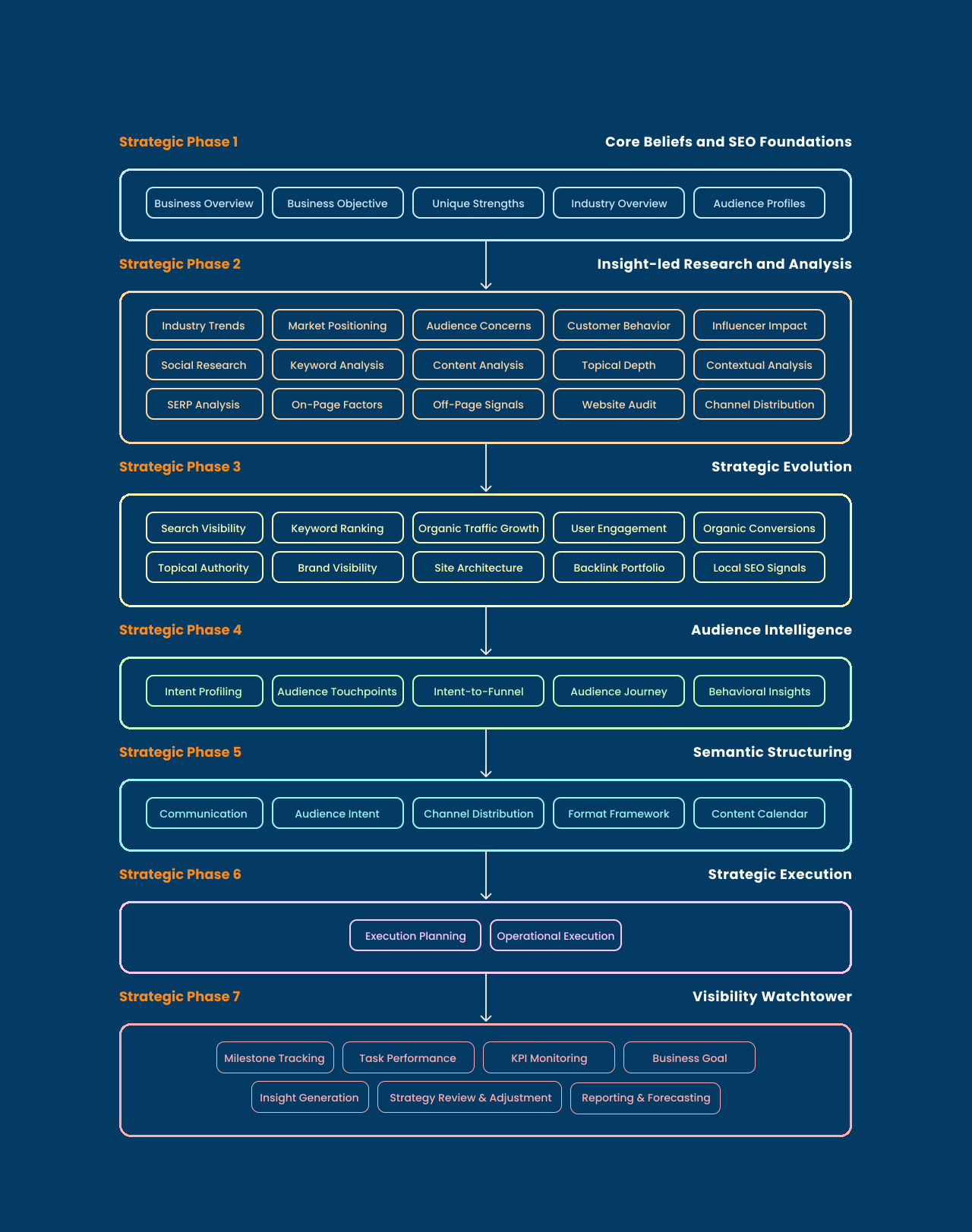
A Strategic SEO Framework for Core Business Alignment
Inbound Connections
This foundational phase does not receive inputs from other RuledSEO phases. Instead, it draws its power directly from the source: the business itself. Its inputs are the core truths provided by leadership and stakeholders, including clearly defined business goals, operational realities, and the brand's unique identity.
Phase At-a-Glance
To anchor every SEO action in the client’s business reality, customer truth, and market direction, ensuring perfect alignment from day one.
view_quilt Pillars
Business Overview
Unique Strengths
Industry Overview
Audience Profiles
check_circle Problems Solved
Ends the struggle of proving SEO ROI by linking every action to business goals.
Prevents wasted effort on keywords and content that don't convert.
Aligns your team, stakeholders, and clients with a single, unified purpose.
The Heartbeat of Strategic SEO
At the core of every successful, long-term SEO strategy lies a deep and unwavering understanding of the business it serves. This is where assumptions end and clarity begins. This is the start of RuledSEO.
Welcome to Phase 1: Core Beliefs & SEO Foundations.
This is not a phase about keywords, algorithms, or technical tweaks. It’s about a single, powerful concept: alignment. It's the disciplined practice of synchronizing SEO strategy with your client’s business model, their audience's true intent, and the long-term value you are tasked with creating. While most SEO efforts begin with a flurry of tactical activity, the RuledSEO framework mandates a strategic pause. We stop to listen, understand, and align before we ever act.
This phase is the strategic ignition point for our entire SEO operating system. It's what separates a professional, results-driven campaign from a series of disjointed tasks. It’s the difference between being a tactical service provider and a trusted strategic partner. By establishing this foundational clarity from the outset, you ensure that every subsequent action is precise, purposeful, and powerful. Without it, even the most well-executed SEO is a gamble.
Why This Foundation Is a Non-Negotiable
SEO without deep alignment is just noise. You might achieve high rankings and impressive traffic numbers, but the client won't see an impact on their bottom line. This disconnect is the single most common reason why talented SEO professionals struggle to prove their value, get sustained buy-in from stakeholders, and command the resources they deserve. This is the problem RuledSEO was designed to solve.
This phase bridges the critical gap between the C-suite and the campaign, between leadership and execution. It brings founders, CMOs, and SEO teams into strategic sync from day one, establishing a shared language rooted in business goals, not just SEO jargon. It is the ultimate preventative measure against "strategic debt"—the accumulation of reactive decisions, disjointed reports, and wasted content that plagues so many well-intentioned but misaligned campaigns.
By starting here, you build a strategy that is resilient. Market trends will change, competitors will launch new campaigns, and search algorithms will shift, but the core beliefs of a business provide a stable compass for navigation. An SEO strategy anchored to these fundamentals doesn't break; it adapts.
The Business Overview
Before you ever open a keyword research tool, you must first become a student of the client’s business. This means going beyond a surface-level understanding to deeply map their complete business model, their specific product or service offerings, their pricing structure, and their operational realities. How do they make money? What are their profit margins? Who are their most valuable customers? What are their operational constraints?
Why It Matters
Without this holistic context, your keyword strategy is a shot in the dark. It is impossible to determine a keyword's true value without understanding the business model it serves. You might target a high-volume keyword related to a low-margin service the business is phasing out, or a term that attracts customers who are a poor fit for their sales process. Understanding the business model is the lens through which all other SEO decisions are brought into sharp focus.
How it works
The strategic thinking is to move beyond high-volume, misaligned keywords. A practitioner first maps the client's business model to identify the most profitable customer segment. This insight shifts the focus from broad terms like "free project management software" to niche, high-intent queries such as "best project management software for marketing agencies," ensuring the SEO effort attracts the right audience for a clear, positive return on investment.
The Unique Strengths
Every business has an edge—a unique selling proposition (USP) that makes its product, service, brand, or approach different and demonstrably better than the competition. This pillar is about identifying, clarifying, and codifying that unique strength so it can become the central theme of your SEO strategy.
Why It Matters
In crowded, competitive markets, trying to win by being just another voice is a recipe for failure. Your client’s unique strengths are the cornerstone of differentiation. They inform your entire SEO narrative, shape your content's tone and focus, and even guide your link-building and digital PR strategy. It allows you to build a defensible "moat" around a unique position in the market.
How it works
Success is demonstrated by translating SEO efforts into core business metrics, moving beyond vanity figures. The thinking involves establishing a direct link between the organic strategy (e.g., targeting high purchase intent) and the sales pipeline. Instead of reporting "40% traffic increase," the approach calculates and reports the number of marketing-qualified leads (MQLs) generated and their estimated dollar contribution to sales, proving strategic value to the C-suite.
The Industry Overview
Your client’s business does not operate in a vacuum. This pillar involves a comprehensive analysis of the broader market context. This includes understanding the industry's maturity (is it new and emerging, or old and saturated?), its seasonality, and the competitive landscape. It also means identifying not just direct competitors, but also indirect competitors (who solve the same problem in a different way) and aspirational competitors (who are the established leaders in the space).
Why It Matters
This vital context shapes the entire tone, pace, and realism of your strategy. In a highly saturated market, an aggressive, direct attack on competitive head terms is likely to be a costly failure. In a new, emerging market, the primary goal might be to create content that defines the category itself. This analysis ensures the goals you set are ambitious but achievable.
How it works
The strategic decision-making process is grounded in market realism. The thinking first assesses industry maturity and competitive saturation to set achievable goals. Instead of a costly, direct attack on broad, entrenched terms owned by industry giants, the approach focuses on dominating an emerging, high-value sub-category—for example, "AI for regulatory compliance in marketing"—to establish topical authority and secure a foothold with core customers first.
The Audience Profiles
The final and most important pillar dictates that SEO must always start with the searchers, not the search engines. This pillar is dedicated to defining exactly who the client serves. This goes far beyond basic demographics to uncover their deep-seated pain points, their professional goals, their primary fears, and their level of awareness and sophistication at each stage of their decision-making journey.
Why It Matters
These deep audience profiles are what shape your intent mapping, which is infinitely more valuable than a simple keyword list. Understanding what your audience truly worries about or desires allows you to create content that resonates on a deep, emotional level. This is how you build trust, authority, and brand preference far more effectively than with content that simply matches a keyword string.
How it works
The strategic imperative is to move from informational content to emotional resonance. The thinking is to identify the audience's deep-seated fears—such as "outliving their savings"—beyond surface-level demographics. This emotional core then shapes the entire content strategy. Content shifts from dry, academic topics like "retirement planning" to empathetic, problem-focused narratives, driving higher engagement and a massive increase in qualified client inquiries by providing peace of mind.
Strategic Outcome: A Foundation of Clarity
By completing this foundational phase, you don't just have a plan; you have unshakable clarity. You unlock a unified strategic direction that is understood and shared across marketing, SEO, and the C-suite. Your SEO tactics are never executed in a vacuum; they are always in service of a larger, agreed-upon goal. Your content themes are intrinsically tied to customer value, not just search volume. Your entire strategy becomes more resilient to the inevitable shifts in search engine algorithms because it is anchored in timeless business fundamentals, not fleeting tactical trends. You have built your house on rock, not sand.
Next Step: From Clarity to Insight
You now have a foundation built on absolute clarity. With a direct line connecting your strategy to core business objectives, the path forward is clear and purposeful.
But the question becomes: how do you use this powerful alignment to fuel your research and generate intelligence that your competitors are missing?
This is the entire purpose of the next phase. It’s where we take your foundational strategy and use it as a lens to conduct insightful research and analysis—a process that not only uncovers hidden opportunities but ensures every discovery is tied directly back to your ultimate business goals.
Ready to transform your strategic clarity into actionable intelligence? Let's dig deep and uncover what truly matters.