AI SEO Tools: 8 Hidden Limits That Quietly Break Real Projects
AI SEO tools are brilliant at automating tasks and blind to the project. Here are eight ways raw AI breaks down on real work — and the system that closes the gap.
AI SEO tools have become the default in almost every workflow, and the speed is real. The trouble starts the moment you try to turn a thousand fast answers into one coherent project that holds together for six months. That is rarely a limit of intelligence. It is a limit of structure.
Why AI SEO Tools Feel Like Progress
Adoption is now near-universal. The share of SEO professionals using AI in their workflow climbed from 65% in 2024 to 86% in 2025 — the steepest single-year tooling jump on record — and the average enterprise team runs around four different AI tools at once.[1] The tools clearly work. They produce output, and they produce it fast.
But output is not the same as outcome. A brief, a keyword cluster, a rewritten title tag, a generated meta description — each is a task finished in seconds. A six-month engagement is not a pile of finished tasks. It is a sequence of decisions that have to stay consistent with one another over time, against a goal that does not change just because the chat window did.
That is where most AI SEO tools quietly fall short. Not because the model is not smart enough, but because nothing underneath it is holding the project together between one fast answer and the next.
Automation Is Not Strategy: What AI in SEO Actually Does
Here is the distinction the marketing around AI in SEO keeps blurring: a tool that automates a task is not the same as a system that does SEO.
Automation is task-level. It compresses the time a single step takes — writing, summarising, clustering, diagnosing. That is genuinely valuable, and you should use it without apology.
Strategy is project-level. It decides which tasks matter, in what order, against which goal, for which audience — and then remembers that decision next week when you sit back down. AI can accelerate the tedious parts of SEO, but a human still owns accuracy, validates the work, and keeps the model from confidently going wrong.[2]
The gap between those two layers is not a sharper-prompt problem. It is structural. And it shows up in eight predictable ways the moment a real project grows longer than a single conversation.
8 Ways Raw AI Breaks Down on Real SEO Projects
None of these eight failures are about intelligence. Every single one is about the missing layer beneath the chat.
1. Context window — there is a hard ceiling on how much the model can see at once. A long project of audits, keyword maps, and past decisions does not fit. The model reasons about a fraction of your project and presents it as the whole.
2. Rolling context — as a chat grows, the earliest decisions silently fall out of view. Your brief erodes mid-conversation while the tone stays exactly as confident as it was on the first message.
3. Project context — every new chat is day one. Open a fresh session and the model has no idea what was decided yesterday. You re-explain the business, the goal, and the constraints every single time.
4. Tool choice overwhelm — expose a model to dozens of tools and it picks wrong, picks late, or picks nothing. Without a layer that governs which tool fires when, more integrations make the system less reliable, not more.
5. Reasoning black box — you get conclusions, not the chain that produced them. There is no traceable path from data to decision, so you cannot check the work, defend it to a client, or reproduce it later.
6. No storage — the sharpest insight of the week is generated in a chat, read once, and gone the moment the tab closes. Knowledge that is not stored is not an asset. It is a one-time performance.
7. No retrieval — even when something is saved, it is rarely structured, so the right fact never resurfaces at the right moment. Unretrievable knowledge is functionally the same as no knowledge.
8. Hallucination — under uncertainty, the model fills the gap with fluent fiction and states it as fact. AI tools have invented fake legal citations that were filed in court, recommended businesses that do not exist, and fabricated stats, prices, and URLs. In SEO, a hallucinated metric that looks clean can steer an entire quarter the wrong way.[3]
It's Not an Intelligence Problem — It's a Structure Problem
Read those eight failures back to back and a pattern appears. Not one of them is fixed by a better model. A larger context window pushes the ceiling higher; it does not give you persistence. A sharper reasoner still cannot retrieve a decision it had nowhere to store.
Every limitation traces back to the same missing layer: there is no single place that stores what you learn, tracks what you decide, and monitors what happens next. Raw AI is brilliant at the task and blind to the project.
It's not an intelligence problem. It's a structure problem. The fix is not a smarter chat — it is a structure beneath the chat that gives it memory, order, and an audit trail.
From AI SEO Tools to an SEO System: RuledSEO OS and MCP
This is exactly the gap the RuledSEO OS is built to close. It is a persistent knowledge workspace — an MCP-native layer that sits beneath your AI SEO tools and turns scattered outputs into a project that actually accumulates.
Where raw AI forgets, the OS remembers. It stores every insight, audit finding, and decision in a structured workspace instead of a disposable chat. It tracks the decisions and the reasoning behind them, creating the audit trail raw AI cannot give you. And it monitors KPIs, rankings, and milestones in one place over time, so performance is observed continuously rather than rediscovered from zero each session.
The Model Context Protocol (MCP) is what makes this native rather than bolted on. Instead of overwhelming a model with dozens of disconnected tools, MCP gives it governed, structured access to the workspace — the right context and the right tool at the right moment. That directly answers the tool-overwhelm and no-retrieval problems, because the model is no longer guessing. It is operating against a system.
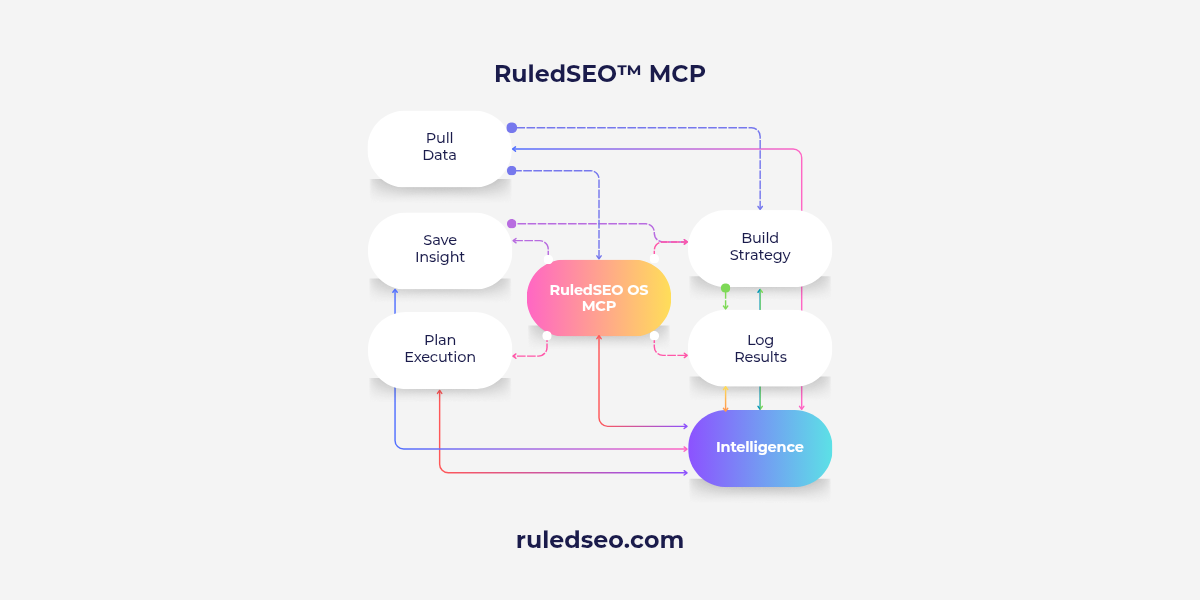
Sitting on top of all of it is the RuledSEO Framework — a 7-phase, 53-pillar methodology that supplies the order. The OS holds the memory; the Framework supplies the sequence. Its final phase, continuous visibility monitoring, is precisely where rankings and KPIs are tracked over time instead of checked once and forgotten.
What SEO Automation Looks Like With a System Underneath
The point is not to abandon automation. It is to give SEO automation a foundation so the speed compounds instead of leaking away. With a structured system underneath, the same AI tools start to behave differently.
A brief written today is retrievable next month, with its reasoning attached. A strategy decision is stored once and referenced everywhere, so the brief stops eroding. A new session starts warm, with yesterday's context loaded. Outputs are checkable, because the path from data to decision is logged. And claims are grounded against your stored data, which shrinks the room hallucination has to operate in. That is the difference between using AI to do tasks faster and using AI to run a project well.
The Takeaway for SEO Professionals
AI SEO tools are not the problem, and they are not going away — 86% adoption is not a trend you opt out of. But it is worth being honest about what they are. They are extraordinary at automating the task, and structurally incapable, on their own, of holding the project.
Close the gap with structure, not a bigger prompt. Store what you learn, track what you decide, monitor what happens — in one place. That is the shift from using AI SEO tools to running an SEO system, and it is the whole idea behind the RuledSEO OS and Framework. Because in the end, it was never an intelligence problem. It was a structure problem all along.
References
Sources referenced above, by number:
1. Aira — State of SEO 2025 (AI adoption data)2. Search Engine Land — Will AI replace SEO?3. Search Engine Land — Agentic AI and SEORead Next
More from RuledSEO
Google's Official AI Search Optimization Guide: 5 Principles That Validate RuledSEO™ Approach
Google's own AI search guide confirms the principles the RuledSEO Framework was already built around.
Read article →For SEOs"Crawled – Currently Not Indexed" Is a Strategy Problem, Not a Technical Problem
Why Google's deliberate choice not to index says more about your content strategy than any crawl report.
Read article →For BusinessesWhat Defines Successful SEO in 2026
SEO is judged by what is easiest to measure — but is it actually driving business results?
Read article →